

Companies spend months looking for capable mid-level managers. They hire people with energy, judgement and the ability to get things moving.
Then, a year or two into the role, those same managers start to slow down. They hesitate. They become the person every decision has to pass through.
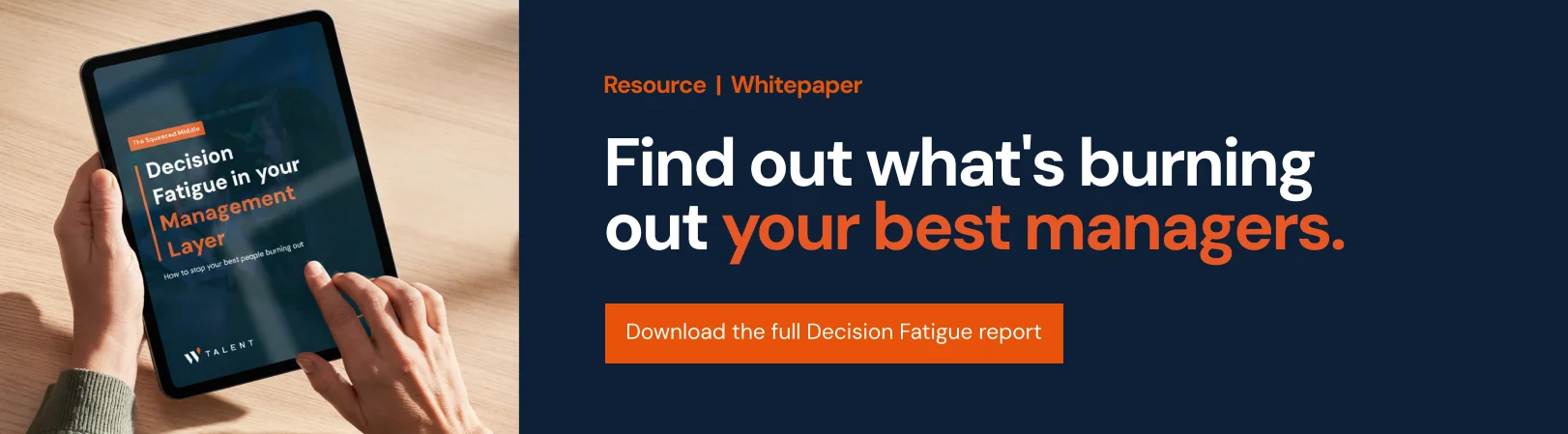
That is the problem explored in W Talent's Decision Fatigue Report 2026: good leaders can become bottlenecks when too many decisions sit with them for too long.
The issue is rarely a lack of ability. More often, it is load. Managers are carrying too many choices, too many approvals and too much context in their heads. Over time, that pressure affects the quality of their decisions and the pace of the teams around them.
What decision fatigue does to managers
Decision fatigue is the decline in decision quality after repeated choices. The basic idea is simple: the more mental effort a person spends on decisions throughout the day, the harder it becomes to make good ones later on.
The report includes the often-cited estimate that the average person makes around 35,000 decisions a day. For managers, the load is heavier because the decisions tend to carry more consequence. They are weighing priorities, people issues, delivery risks, client demands and commercial pressure at the same time.
Roy F. Baumeister's work on ego depletion argued that self-control and willpower draw on limited internal resources [1]. Cognitive load research points in a similar direction: when working memory is overloaded, reasoning becomes harder and people lean more heavily on shortcuts [2].
In practice, that can look like delayed decisions, safer choices, more reactive calls and a gradual preference for whatever feels easiest to approve. The manager is still working hard. They are just working through a tired brain.
Why the middle gets squeezed
Mid-level managers sit in a difficult part of the organisation. Senior leaders expect them to turn strategy into action. Their teams expect clarity, feedback and day-to-day support. They often have limited authority, but plenty of accountability.
Several pressures make that load worse.
- Planning cycles are shorter, so managers have to translate new priorities into practical work more often.
- Decisions cut across more teams, which means a single call can affect technology, finance, operations or HR.
- Micro-decisions fill the day. The report cites research suggesting that a typical tech lead may deal with 20 to 40 of these small calls every day [3].
- As teams grow, the number of people, projects and dependencies grows with them.
Without a better system for routing decisions, the manager becomes the system. Everything slows down because too much knowledge and permission sits in one place.
The business cost
The effect is not limited to the manager. Once decisions pile up in the management layer, the whole team starts to feel it.
Projects wait for approval. Small issues take longer to clear. People stop using their judgement because they know the safest route is to ask the manager first. That creates more decisions for the manager, which makes the bottleneck worse.
The report cites research showing that employees experiencing high fatigue have a 23% lower productivity rate than their peers [4]. It also links fatigue with more reactive decisions, with fatigued employees making two to three times more suboptimal decisions [4].
Innovation suffers too, although often in a quieter way. Process improvement depends on people making small adjustments close to the work. When managers are overloaded, those adjustments either wait for approval or never happen. The team learns to maintain the current way of working because changing it feels too difficult.
Quality can slip for the same reason. A drained manager has less capacity for careful review, useful feedback and proper coaching. Standards are still discussed, but they become harder to uphold consistently.
The human cost matters as well. The report references data showing that 82% of managers feel burned out, a higher rate than entry-level employees [4]. It also notes that employee trust in management fell from 46% to 29% over two years [5].
That combination is dangerous. You risk losing the managers you worked hard to hire, and the high-potential people underneath them who no longer feel supported.
The problem needs structure
More time management training will not solve this on its own. Neither will simply asking managers to be more resilient.
The problem is structural. Too many organisations route decisions through the same small group of people, then wonder why those people eventually become exhausted.
The Decision Fatigue Report 2026 argues for a different approach: move from approval-heavy management to clearer ownership. That means giving teams defined boundaries, clear escalation routes and enough context to make more decisions without waiting for permission each time.
This is where decision load-shedding becomes useful. Leaders need to be deliberate about which decisions should stay with managers, which can sit with teams, which can be automated and which need a clear escalation path.
Protecting leadership capacity
Decision fatigue is easy to miss because it often looks like diligence. The manager is present in every conversation. They are copied into every thread. They know the detail. On the surface, it can look like strong leadership.
Over time, though, that level of involvement becomes fragile. The team depends too heavily on one person, and the manager loses the space to think properly.
The Decision Fatigue Report 2026 by W Talent sets out the Four Pillars of Structured Decision-Making, a framework for reducing decision overload and building more ownership into teams.
For organisations that want to keep good managers, the question is whether the business has built a structure that lets them lead without becoming the bottleneck.